
Are Bitcoin's 4-year cycles dead?
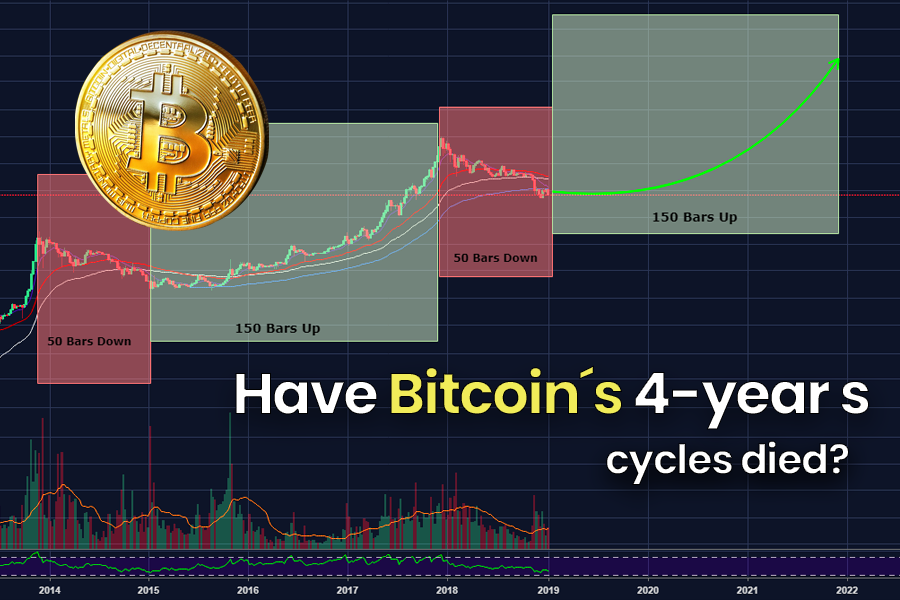
For years, one of the most popular narratives within the Bitcoin ecosystem has been the 4-year cycle theory.
The idea seemed simple:
• Halving
• Bull market
Euphoria
Sharp correction
And then repeat the process
Many traders built entire strategies around this historical pattern.
But today, in 2026, the market is sending a very different message:
What if Bitcoin no longer moves primarily through cycles… but through institutional capital flows?
And more importantly…
What if we are entering a new era for Bitcoin?
The origin of the 4-year cycles
The theory originated around the Bitcoin halving.
Approximately every 4 years, the issuance of new bitcoins is halved, decreasing the new supply available on the market.
Historically, this has coincided with major upward movements:
• Halving 2012 → Bull run 2013
• Halving 2016 → Bull run 2017
• Halving 2020 → Bull run 2021
This led many to assume that Bitcoin was a completely predictable asset based on cycles.
But there is an important detail:
Markets evolve.
And Bitcoin is no longer the same asset it was years ago.
Bitcoin is no longer a small market
Previous cycles occurred in a completely different environment:
• Little institutional interest
• Low liquidity
• Less financial infrastructure
• Market dominated by retail and speculation
Today the situation changed radically.
Now there are:
• Bitcoin spot ETFs
• Bitcoin treasury companies like Strategy and Strive
• Public companies accumulating BTC
• Institutional funds entering the market
• Banks offering exposure to Bitcoin
• Governments openly discussing regulation and digital reserves. Bitcoin is no longer an alternative experiment.
It is evolving into a global financial asset.
The new market force: institutional capital
Investors like Michael Saylor and Mark Moss have long championed an idea that today seems more relevant than ever:
Bitcoin no longer moves solely based on scheduled events.
It is driven by structural capital demand.
And recent numbers help explain why.
Strategy, led by Michael Saylor, continues to aggressively accumulate Bitcoin even during periods of volatility. In April 2026, the company surpassed 815,000 BTC in reserves, becoming one of the world's largest institutional holders.
Meanwhile, Bitcoin spot ETFs continue to attract billions of dollars in capital inflows, solidifying Bitcoin as an asset increasingly integrated into the traditional financial system.
So… what does this really mean?
This means Bitcoin may be entering a stage where:
• Institutional liquidity dominates the market
• Deep dips are absorbed more quickly
• Historical behavior loses strength
• And the supply available on exchanges continues to decrease
Currently, Bitcoin reserves on exchanges are at multi-year lows, while major players continue to accumulate.
That completely changes the dynamics.
Because when large institutions are constantly buying Bitcoin, we are no longer simply talking about "traders speculating".
We are talking about strategic capital entering the scarcest asset on the planet.
The mistake could be continuing to think like we did in 2017
Many investors are still waiting for:
• “The next 80% drop”
• “The next massive bear market”
• “The perfect opportunity to buy low”
But the market in 2026 is not like the one in 2017.
Today there is:
• Greater financial maturity
• Greater institutional adoption
• Greater infrastructure
• Greater regulatory clarity
• And a much stronger narrative around Bitcoin as a store of value
Even during recent corrections, the market has shown a much greater ability to absorb sales and recover significant levels quickly.
Bitcoin is maturing
This does not mean that Bitcoin will cease to be volatile.
Volatility remains a natural part of an emerging market monetary asset.
But it could mean that:
• Cycles will be less extreme
• Recoveries will be faster
• And movements will be increasingly linked to global capital flows and monetary policies, not just the halving
In other words:
Bitcoin is evolving from a small speculative market…
To become a global financial layer.
Our vision at UnitedHodl
At UnitedHodl we maintain a clear and bullish vision:
Bitcoin is not just an asset for trading cycles.
Bitcoin is a monetary revolution in the process of global adoption.
And when you understand that, it completely changes your perspective.
You stop thinking only about:
• “Timing el mercado”
And you start thinking about:
• “Accumulating the world’s scarcest asset before everyone else”
Conclusion
The 4-year cycles were useful for understanding Bitcoin's past.
But the future could work very differently.
The aggressive influx of institutional capital, the expansion of spot ETFs, and companies like Strategy accumulating hundreds of thousands of BTC are completely transforming the market structure.
The message seems increasingly clear:
Bitcoin is maturing.
Y cuando un mercado madura…
Simple patterns begin to break down.