
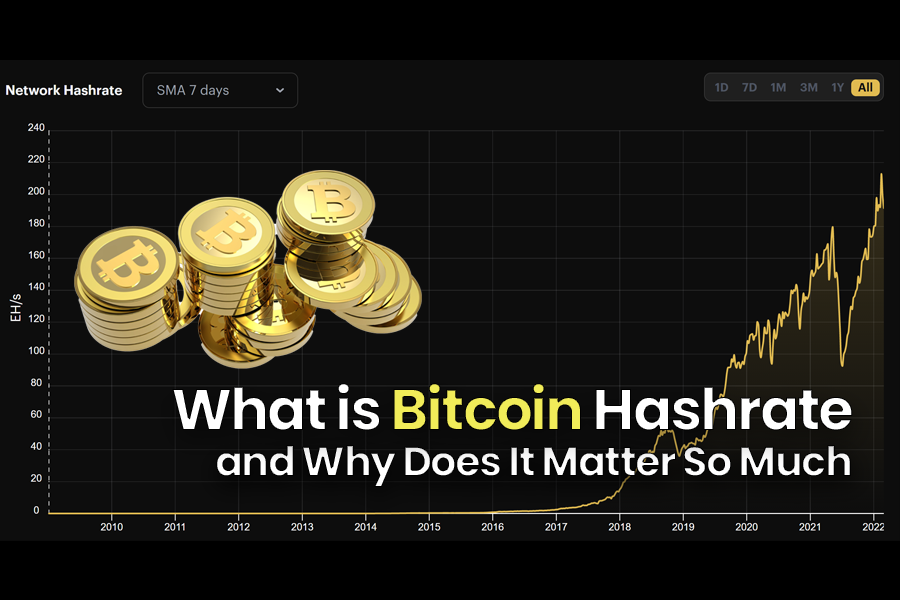
What is Bitcoin Hashrate and why does it matter so much?
In the world of Bitcoin, there are several important metrics that help us understand the health and security of the network. One of the most relevant, but least understood by beginners, is hashrate . Today, I'll explain it in a simple way. I'll tell you how it influences the price of Bitcoin and why this metric has historically been a bullish sign for serious hodlers.
So… what is hashrate?
Hashrate is basically the amount of computing power being used to process and secure the Bitcoin network. Every time someone makes a transaction, miners compete to validate it by solving complex mathematical problems, and that competition uses computing power
This power is measured in hashes per second (H/s) , which is the number of attempts made to solve these problems in one second. Today, this figure is measured in exahashes per second (EH/s) , because the network is enormous.
To give you an idea:
1 exahash equals 1,000,000,000,000,000,000 hashes per second .
That's how big the Bitcoin network is.
Why is hashrate important?
Hashrate is like Bitcoin's immune system. The higher it is, the harder it is to attack the network. If an attacker wanted to take over Bitcoin (what's called a 51% attack), they would have to have more computing power than the entire network combined. And since the hashrate is at historic highs, that scenario is practically impossible.
A high hashrate means:
Greater security.
Greater trust in the network.
Greater decentralization.
The relationship between hashrate and Bitcoin price
Here's the interesting part. Historically, spikes in hashrate have been an early indicator of major Bitcoin price increases. And it's no coincidence.
As more miners connect to the network, investing millions of dollars in hardware and energy, they do so because they believe in Bitcoin's long-term value. No one sets up a mining farm overnight. It's a serious bet on the future.
Let's look at some examples:
- In 2017 , before Bitcoin broke $20,000 for the first time, the hashrate skyrocketed.
- In 2020-2021 , following the halving, the hashrate reached all-time highs and the price rose from $10,000 to over $60,000 in less than a year.
- Today , in 2025, the hashrate is back at record levels, and we've already seen Bitcoin break $100,000.
Every time the network strengthens, the market takes note.
Why is a high hashrate a bullish signal?
Because it's a reflection of institutional and miner confidence in the network. If miners keep connecting more machines, it means they're betting that Bitcoin will continue to be worth more in the future. Furthermore, with each new halving (when block rewards are cut in half), miners need the price to rise to keep their business profitable. And so far, Bitcoin has delivered in every cycle.
Conclusion: The pulse that indicates Bitcoin's health
Hashrate is one of the most important and least appreciated metrics by the general public, but those of us who have been in this ecosystem for a while know how to interpret it as a sign of strength. It's like seeing a city with more and more walls, better security systems, and more citizens working to keep everything running smoothly.
Every new hashrate record is proof that Bitcoin is not only still alive, but stronger than ever. And if history repeats itself, that can only mean one thing: prepare for new heights in price.
So, the next time you hear about hashrate, think of it as Bitcoin's heartbeat. And if that heartbeat is beating fast… you know what's coming.
Hold tight. Bitcoin doesn't stop.