
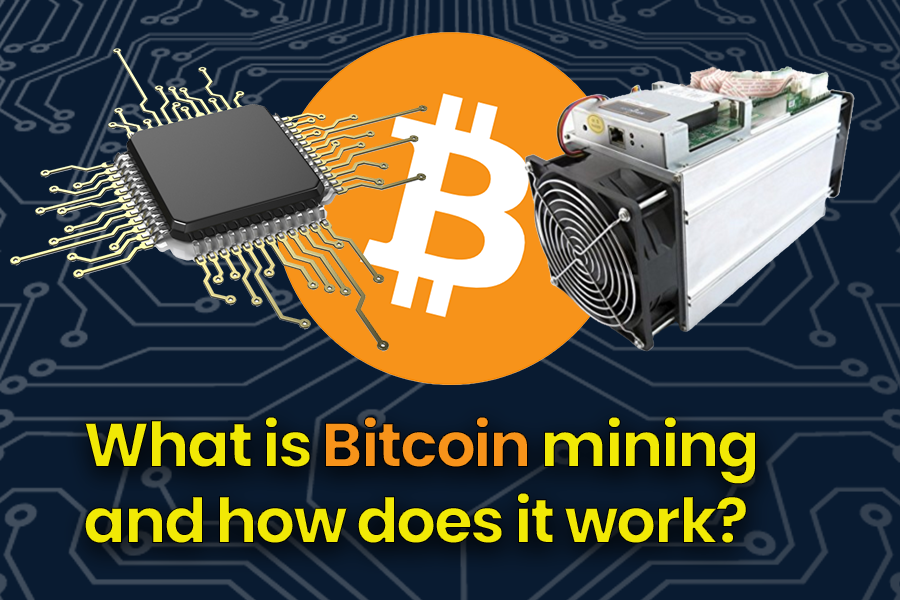
What is Bitcoin mining and how does it work?
Imagine if the world's financial system had an invisible engine that keeps everything running, without the need for banks or intermediaries.
That engine exists, and it's called Bitcoin mining..
Mining is the process by which transactions are validated and recorded within the Bitcoin network. Instead of relying on a central authority, thousands of computers around the world compete to solve highly complex mathematical problems.
When one of them manages to solve the puzzle, it adds a new block of transactions to the blockchain (Bitcoin's large public database) and receives a reward: new bitcoins and the fees from those transactions..
Thus, miners not only help keep the network running, but also make Bitcoin secure, transparent, and trustworthy..
Proof of Work (POW): The Heart of the System
Bitcoin uses a mechanism called Proof of Work..
Simply put, it's a global competition of computers competing to solve a mathematical problem.
The first to solve it wins the right to add the next block to the chain... and receives their reward.
Why is this system important?
- Security: Makes attacking the network virtually impossible, because it would require a huge amount of energy and resources.
- Decentralization: No one can control Bitcoin; everyone competes on a level playing field.
Yes, it requires a lot of energy, but it's also what gives Bitcoin its resilience and neutrality. It's the cost of having truly free money.
From PCs to ASICs: The Evolution of Mining
In the early years, anyone could mine Bitcoin from their personal computer (CPU).
Later, GPUs (graphics cards) came along, offering more power.
Today, mining is done almost exclusively with specialized equipment called ASICs (Application-Specific Integrated Circuits) ..
Why did ASICs dominate?
- Efficiency: They are designed solely for mining Bitcoin, so they consume less energy per calculation.
- Performance: They have processing power thousands of times greater than that of a normal PC.
The downside is that they are expensive and consume a lot of electricity, so mining from home is no longer as profitable as it used to be.
Mining difficulty: an automatic balance
Bitcoin is designed so that each block is created approximately every 10 minutes ..
To maintain that pace, the network automatically adjusts its difficulty every two weeks (every 2,016 blocks).
- If too many miners are working and blocks are mined too quickly → the difficulty increases..
- If there are fewer miners or blocks take too long → the difficulty decreases..
This mechanism keeps the network stable, predictable and self-sufficient, without the need for human intervention.
The “halving”: when the reward is split in two
Approximately every four years, a key event called the halving occurs..
At this point, the reward miners receive for each block is cut in half..
Why?
Because Bitcoin has a maximum supply of 21 million coins..
The halving controls the issuance of new bitcoins and ensures that there is an ever decreasing supply.
Effects of the halving:
- Miners earn less per block.
- New bitcoins in circulation are decreasing.
- Scarcity is increasing… and with it, historically, the price.
Each halving marks a new era in the Bitcoin economy.
Energy and environment
One of the most debated topics about mining is its energy consumption.
Yes, the Bitcoin network consumes a lot of electricity, but that 's not necessarily a bad thing..
Every day, more miners are using renewable energy, taking advantage of surplus electricity, or setting up in places where energy is cheap and underutilized, such as dams or geothermal plants.
Furthermore, competition drives a constant search for greater efficiency..
Mining is evolving, and so is its environmental impact.
Mining pools: mining as a team
Mining alone is very difficult these days.
That's why mining poolsexist , which are groups of people who pool their computing power to increase the odds of earning rewards.
When the pool successfully mines a block, the profits are shared among everyone based on their contribution.
This allows small miners to receive more frequent and stable payments..
Where is mining concentrated?
The location of mining farms depends primarily on the cost of electricity and local regulations.
For years, China was the leader, but following government bans, activity shifted to North America, Latin America, Eastern Europe, and Central Asia.
Factors that influence:
- Regulatory changes.
- Cost and type of energy.
- Political and economic stability.
The Bitcoin mining map is constantly changing.
Is it profitable to mine today?
It depends.
The profitability of mining varies depending on several factors:
- The price of Bitcoin.
- The cost of electricity.
- The efficiency of the team.
- The difficulty of the network.
Therefore, before investing, it is advisable to calculate the costs carefully and understand that mining is not an easy or quick way to make money: it is a competitive industry.
The future of Bitcoin mining
Bitcoin mining continues to evolve.
Among the most notable trends are:
- Greater adoption of renewable energy.
- Technological innovations that improve efficiency.
- New regulations and migration to more favorable areas.
While other cryptocurrencies use lighter systems like Proof of Stake, Bitcoin stands firm with Proof of Work, as it guarantees security and decentralization like no other.
Conclusion
Mining is the heart of Bitcoin.
Thanks to it, the system has been operating without banks, without permission, and without interruptions since 2009.
It's a complex process, but also one of the most brilliant ideas in modern history: a global network of energy, mathematics, and freedom that underpins the world's most solid money.
Want to learn more about how Bitcoin works, its security, and its real impact on the world?
Visit www.unitedhodl.com